

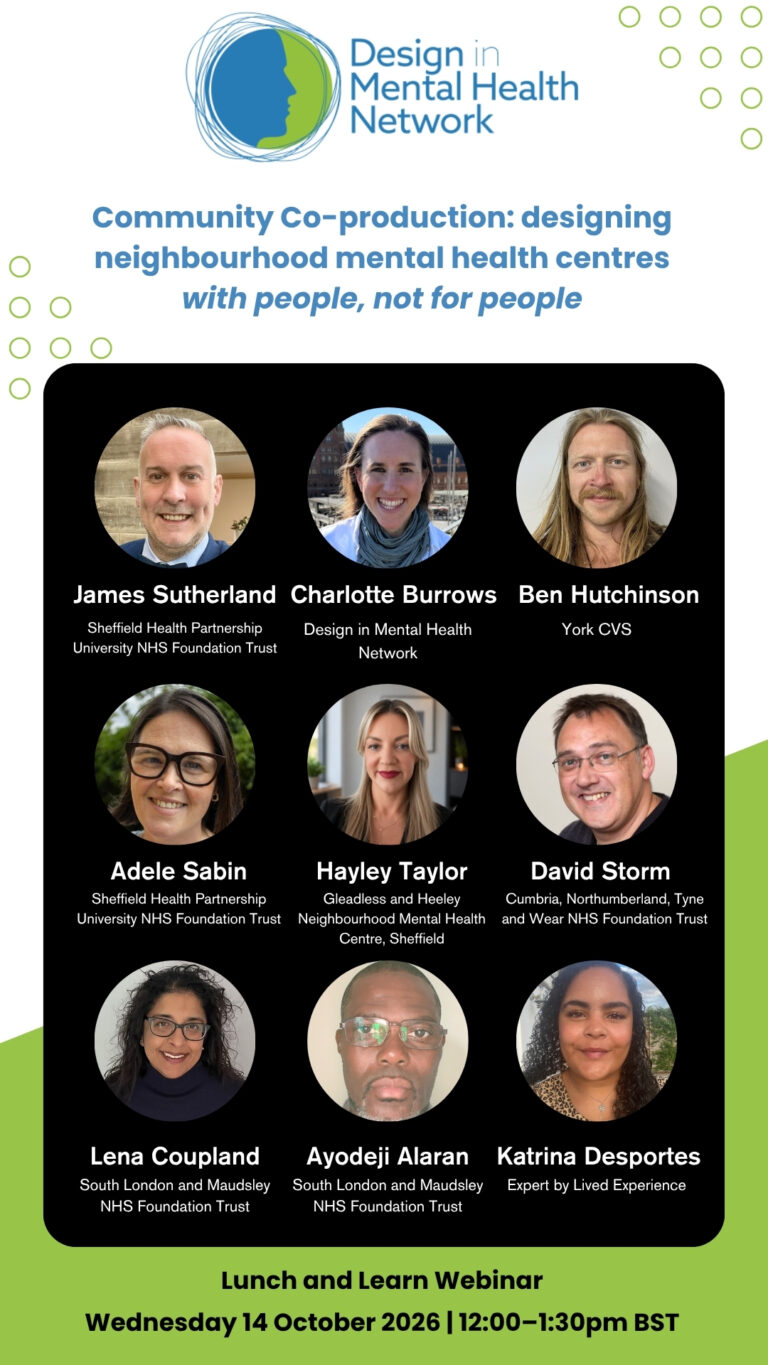
Community Co-production: designing neighbourhood mental health centres with people, not for people
Webinar Reflections | Design in Mental Health Network | 14 October 2026
Better neighbourhood mental health environments begin with people, place and partnerships
What does it really take to design a mental health centre with its community, rather than simply for it?
That was the question at the heart of our October 2026 Lunch & Learn webinar, which brought together people involved in Neighbourhood Mental Health Centre pilot sites in York, Sheffield, Hope Haven and Lewisham.
Co-hosted by Charlotte Burrows, CEO of the Design in Mental Health Network (DiMHN), and James Sutherland, National Specialist Advisor on Community Mental Health Transformation at NHS England, the session explored the practical realities of creating accessible, welcoming and genuinely community-centred mental health environments.
Bringing together lived experience, clinical, estates, design, operational and community perspectives, the webinar went beyond showcasing completed projects.
Speakers shared the decisions, challenges, compromises and relationships behind their work – including what had worked, what proved difficult and what they would approach differently.
One message connected the different experiences:
The starting point for a Neighbourhood Mental Health Centre should not be the building. It should be the people, relationships and model of care the building needs to support.
Learning from the pilot sites
York: The Power of the Brew
Presenter: Ben Hutchinson, Co-production Lead, York

Ben Hutchinson - York CVS
Ben’s presentation explored how small design choices and everyday interactions can significantly influence people’s experiences of mental health care. Drawing on his personal and professional experience, he contrasted traditional clinical environments, with reception screens, locked doors and plastic cups, with more welcoming spaces where people feel trusted, equal and valued.
The central message was that design should begin with how people should feel, rather than what a building should look like.
The importance of welcome and belonging
Simple acts of hospitality, such as offering a cup of tea in an ordinary mug, providing comfortable seating and greeting people warmly, can help reduce anxiety and build trust. Ben challenged assumptions about risk and control, encouraging designers and service providers to consider what physical environments communicate about dignity, equality and belonging.
Bringing care to the person
Ben shared an example of someone who had recently been admitted to hospital and was reluctant to engage with traditional mental health services. Having developed trust within the York hub, the individual was supported by assertive outreach staff and a psychiatrist who visited him there, rather than requiring him to move between services.
Challenging conventional approaches to safety
Ben acknowledged the importance of safety requirements but questioned whether some traditional restrictions unintentionally reinforce institutional environments.
Rather than automatically rejecting ideas because of perceived risks, the York team explored how people’s preferences could be delivered safely.
Strong leadership, effective partnerships, flexible funding and a willingness to challenge established practices were important in making this possible.
Key takeaway
Ben encouraged teams to start by asking how they want people to feel when entering a neighbourhood mental health centre: welcomed, safe, trusted, equal and that they belong.
Sheffield: Turning community voices into design decisions
Adele Sabin and Hayley Taylor
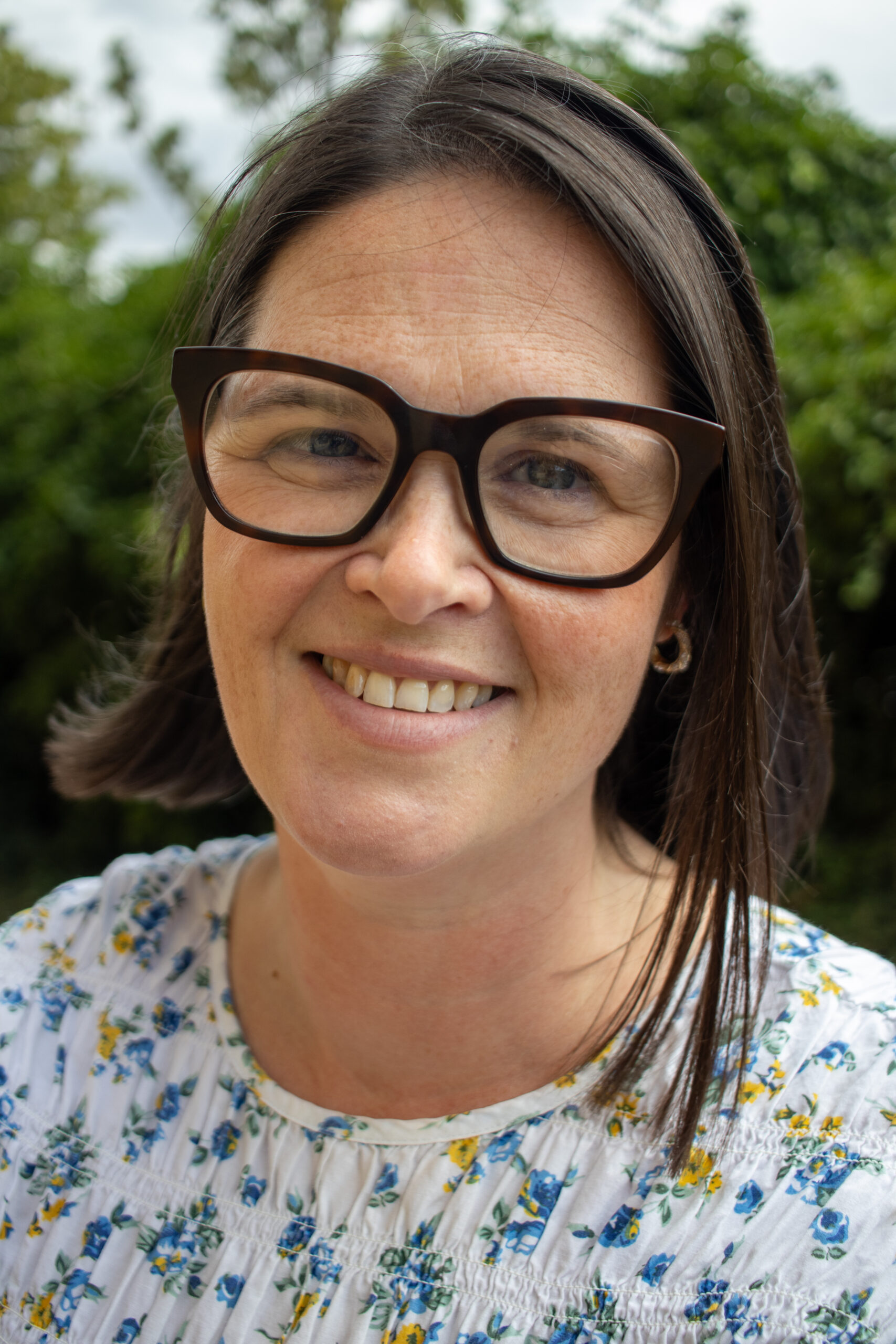
Adele Sabin - Sheffield Health Partnership University NHS Foundation Trust

Hayley Taylor - Gleadless and Heeley Neighbourhood Mental Health Centre, Sheffield
What happens after people tell us what they want?
Sheffield’s contribution explored one of the most important challenges in co-production: translating community aspirations into practical decisions that can be designed, specified, funded and delivered.
A request for somewhere “light and airy”, for example, may sound straightforward.
But what does that mean for daylight, privacy, glare, temperature, energy performance and different sensory needs?
These considerations require conversations between people with lived experience, designers, estates teams and operational colleagues.
The challenge is not simply to translate feedback into a technical specification. It is to preserve the meaning behind the original request while working through the constraints of delivery.
Sheffield’s experience demonstrated why engagement cannot be treated as a single consultation exercise.
The reflection: Listening is only the beginning. Meaningful co-production requires a clear connection between what people say matters and the decisions that follow.
Hope Haven: Challenging traditional estates approaches
Adele Sabin and David Storm

David Storm - Cumbria, Northumberland, Tyne and Wear NHS Foundation Trust
Hope Haven offered a different perspective on what a community mental health environment can be.
Its development challenged assumptions about where mental health support should take place and what a healthcare environment should look and feel like.
The choice of a high-street property reflected an ambition to create somewhere connected to everyday community life, rather than separated from it.
Community involvement influenced the identity and character of the space, while collaboration with estates and delivery colleagues was essential to making that ambition workable.
The example raised important questions about making better use of local assets, communicating technical information accessibly and balancing community aspirations with the practical requirements of creating safe, functional environments.
It also reinforced the importance of involving estates colleagues as creative partners from the outset.
The reflection: Existing property and established healthcare design conventions should not automatically determine what is possible. The starting point should be the experience and support a community needs.
Lewisham: Keeping lived experience at the heart of delivery
Lena Coupland, Ayodeji Alaran and Katrina Desportes

Lena Coupland - South London and Maudsley NHS Foundation Trust

Ayodeji Alaran - South London and Maudsley NHS Foundation Trust
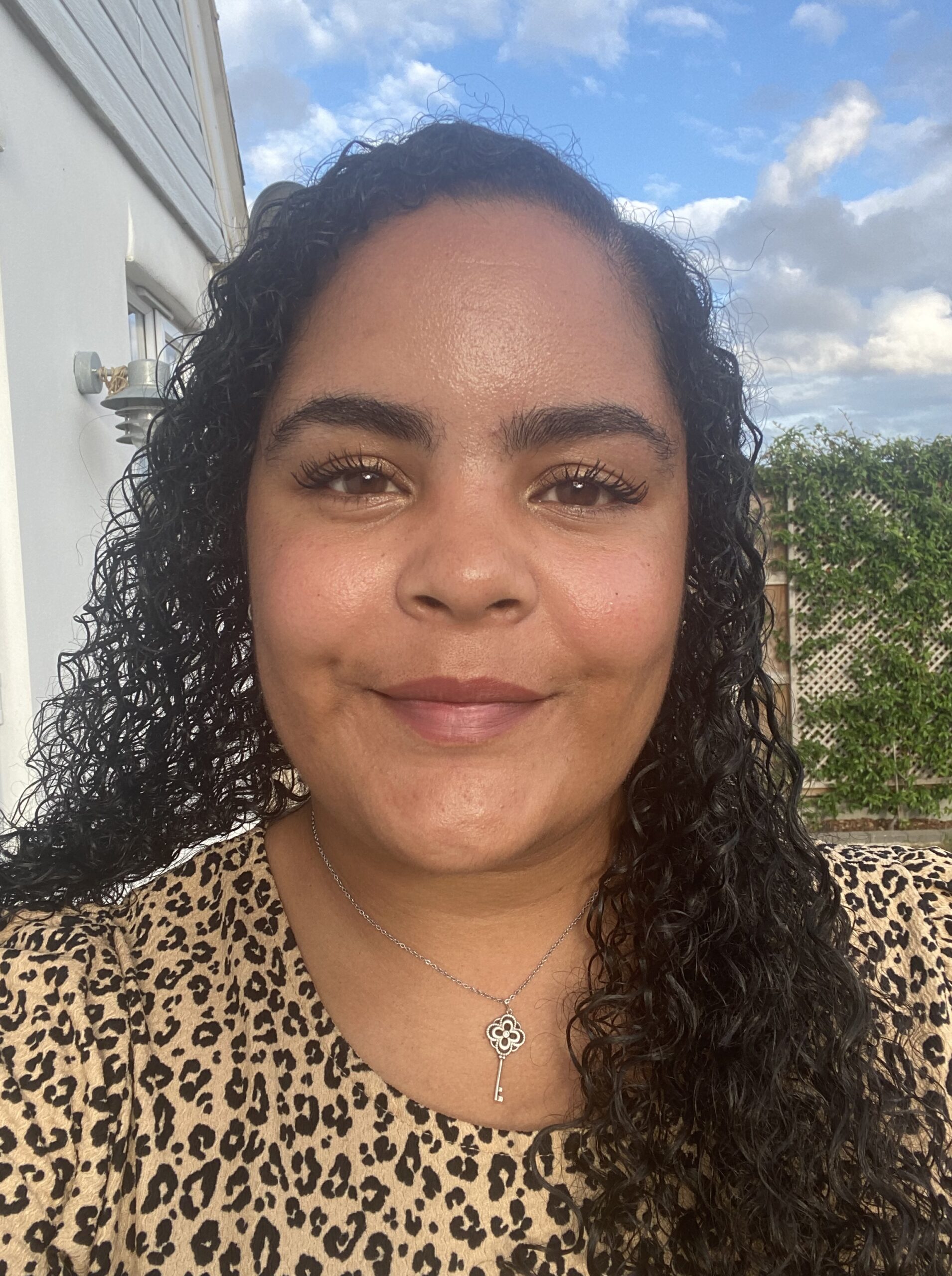
Katrina Desportes - Lived Experience Expert - South London and Maudsley NHS Foundation Trust
Lewisham’s Heather Close Community Mental Health Centre brought attention to the importance of sustaining co-production throughout a project’s development.
The case study explored how people with lived experience and carers were involved in discussions about both the physical environment and the model of care.
This included participation in estates meetings, helping connect decisions about the building with decisions about how services would operate.
The experience highlighted a fundamental distinction: inviting people into a conversation does not necessarily mean they have equal influence within it.
Technical language, professional hierarchies, project timescales and established decision-making processes can all affect meaningful participation.
Lewisham’s approach demonstrated the importance of creating opportunities for different forms of expertise to contribute throughout the project, rather than limiting involvement to an early consultation stage.
It also acknowledged that meaningful co-production takes time.
The reflection: Co-production needs to be embedded in how projects are governed and delivered, not treated as an additional activity alongside the main project.
Key themes and reflections from the webinar
1. Start with the model of care, not the building
Across the discussion, a recurring principle was that buildings must support the intended model of care, rather than dictate it.
Before considering layouts, room schedules or property options, teams need to understand what people should experience when they seek support.
Who needs to feel welcome? What relationships should the environment enable? What barriers might prevent someone from accessing support?
A technically successful building is not necessarily a successful community mental health environment.
2. Co-production must influence decisions
Meaningful co-production is more than gathering feedback.
It requires people with lived experience, carers, community partners and frontline staff to have opportunities to shape priorities, challenge assumptions and influence outcomes.
It also means explaining how decisions are made, including when constraints prevent a preferred option from being delivered.
An important question for every project is:
Can we demonstrate what changed because people were involved?
3. Small details can communicate dignity and belonging
The discussion around hospitality resonated strongly with attendees.
A cup of tea, an accessible welcome, inclusive refreshment choices and the way people are greeted may appear secondary to larger design decisions.
But these details can influence whether a person feels comfortable, respected and able to engage.
As Charlotte Burrows observed in the webinar chat:
“Sometimes it’s the seemingly small design decisions that make the biggest difference.”
These details deserve attention alongside more visible architectural decisions.
4. Estates and operational colleagues are essential partners
Co-production can generate ideas that challenge familiar approaches to healthcare buildings.
Making those ideas work requires collaboration between communities, designers, estates teams, clinicians, operational colleagues and decision-makers.
Engaging these perspectives early creates opportunities to understand constraints, explore alternatives and avoid losing the original ambition during delivery.
5. There is no single blueprint
The four examples demonstrated different responses to different communities, buildings, partnerships and operational circumstances.
A high-street property may be appropriate in one location, while adapting an existing healthcare or community asset may be more suitable elsewhere.
The transferable learning lies less in reproducing a particular building and more in understanding the principles and processes behind it.
6. Honest learning matters
Perhaps one of the most valuable aspects of the session was the willingness to discuss challenges rather than present idealised examples.
Co-production involves negotiation. Property decisions involve compromise. Established systems do not always adapt easily to new ambitions.
Sharing those realities helps emerging teams make more informed decisions and recognise difficulties they may encounter themselves.
The audience conversation: questions that matter
The webinar attracted contributions from across the NHS, local authorities, voluntary and community organisations, architecture and design practices, academia and people with lived experience.
The discussion and Q&A highlighted several questions that deserve continued attention.
How do we embed lived experience throughout delivery?
Attendees raised the importance of meaningful participation in governance, steering groups and operational decision-making, including opportunities for people with lived experience to be employed within services.
How do we translate community ambitions into something deliverable?
Questions about procurement, technical design and estates collaboration reinforced the need for practical examples of how co-production shapes real decisions.
How do the services work once the building opens?
Interest in guest beds and operational arrangements demonstrated that the conversation cannot end at design and construction. How an environment is used and managed is equally important.
How do we hear directly from the people using these centres?
Participants also emphasised the value of learning from experts by experience throughout development and ongoing provision.
Together, these questions point to an important next stage in the conversation: understanding not only how neighbourhood mental health environments are created, but how they work for people in practice.
What attendees said
The feedback reflected a strong appetite for practical examples, honest discussion and continued shared learning.
"Really excellent practical advice for architects on how to work with communities to develop the design."
Lucy Brittain, Cullinan Studio
"Excellent session, love the honesty and real-life examples about how to make this actually happen."
Pat Keeling, North East London NHS Foundation Trust
"This has been really engaging and inspirational. The delivery seems very aspirational, but you have shown it is also doable. Looking forward to hearing more in this space."
Mari Longworth
"So important too to hear directly of the experiences of experts by experience throughout the development and ongoing provision. Amazing work!"
Rosie Allen
What should we explore next? Audience poll results
We asked attendees which topics they would most value in future webinars about Neighbourhood Mental Health Centres.
The responses revealed a clear appetite for practical learning, particularly from projects already working through the realities of implementation.
Preferred topics for future webinars
In order of preference, respondents expressed interest in:
Practical case studies – what worked, what didn’t and lessons learned
Community insight – translating feedback into practical design decisions
Community ownership – making better use of local assets
Collaborative working – engaging effectively with estates and operational partners
Accessible and sensory design – creating more inclusive environments
The strongest preference was for more practical case studies, reinforcing the value of sharing not only successful outcomes but also the decisions and difficulties behind them.
We will use this feedback to help inform future DIMHN learning opportunities and conversations.
Practical takeaways: What should emerging sites consider?
For teams beginning their own Neighbourhood Mental Health Centre journey, the discussion suggests several useful starting points:
- Define the experience before the space. Be clear about how people should access and experience support before deciding what the building should contain.
- Involve people early and keep them involved. Make lived experience and community expertise part of the decision-making process throughout.
- Translate aspirations carefully. Explore what people mean by words such as welcoming, safe, calm or accessible, rather than assuming everyone interprets them in the same way.
- Work across disciplines. Bring estates, operational, clinical, design and community partners together before major decisions become fixed.
- Pay attention to everyday details. Consider how arrival, hospitality, sensory experience, privacy and ordinary interactions contribute to dignity and belonging.
- Be transparent about constraints. Explain trade-offs, maintain dialogue and show how community input has influenced decisions.
- Keep learning after opening. Understand how people experience the environment in use and where further changes may be needed.
Continuing the conversation
This webinar was an opportunity to bring together different perspectives and learn from the practical experiences of people helping shape neighbourhood-based mental health support.
It also reinforced why the Design in Mental Health Network exists.
Better mental health environments require more than good intentions or well-designed buildings. They require evidence, lived experience, professional expertise and genuine collaboration.
As more Neighbourhood Mental Health Centres develop, sharing what works — and what proves difficult — will be essential.
Because designing with people is not simply a stage in a project. It is an ongoing commitment to ensuring environments support the people and communities they serve.
Watch, learn and stay connected
With thanks to all speakers, contributors and attendees for sharing their experiences, questions and insights.